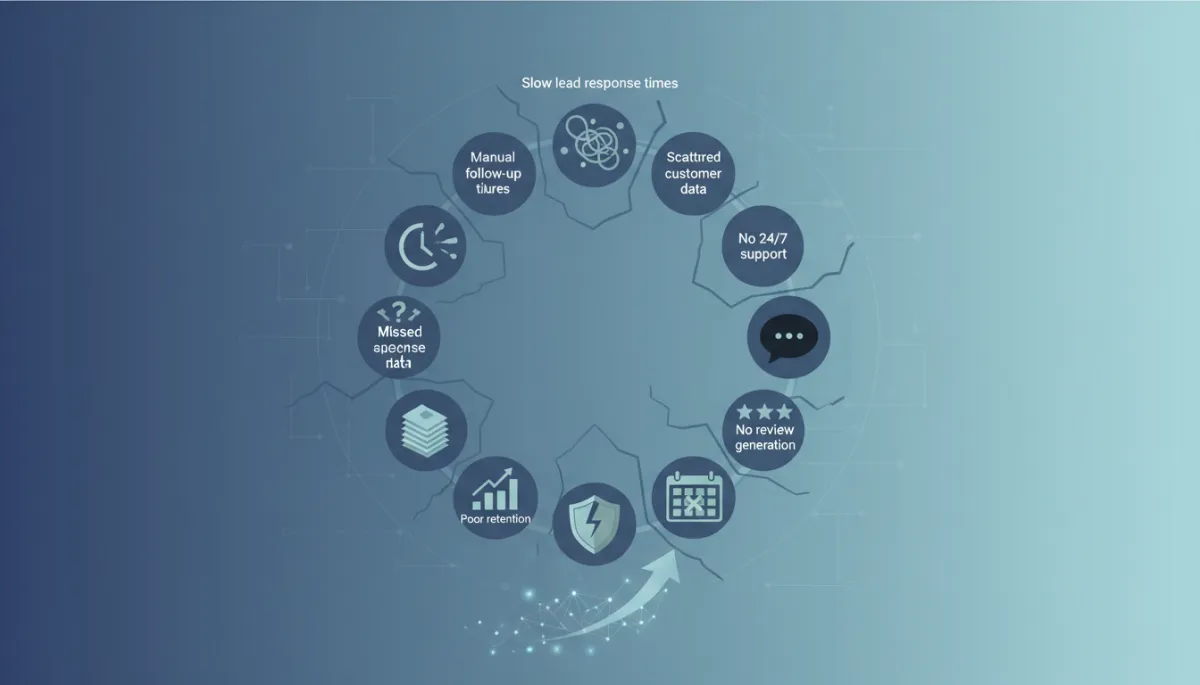
10 Signs Your Business Needs AI Automation
Business Growth, Business Automation Benefits
10 Signs Your Business Is Losing Money Without AI Automation
If you feel like you’re working harder than ever but not seeing the profits you expect, the problem may not be your team, your offer, or even your marketing. It might be the hidden cost of doing everything manually instead of using AI-powered automation. Use this self-diagnostic checklist to spot where money is quietly leaking out of your business every single day.
1. Slow Lead Response Times
When a new lead fills out a form, sends a DM, or calls your business, how long does it take for someone to respond? If the answer is “when we get to it” instead of “within minutes,” you are almost certainly losing revenue. Studies consistently show that the odds of qualifying a lead drop dramatically after just a few minutes of delay. By the time your team replies the next morning, that prospect may already have booked with a competitor who followed up first.
Without AI automation, your lead response depends on who is checking email, watching the phone, or refreshing social media. An AI-powered system can instantly acknowledge inquiries, ask qualifying questions, and even book appointments on the spot. If your leads are waiting hours—or days—for a reply, you’re effectively paying for marketing that benefits someone else’s business.
2. Manual Follow-Up Failures
Most customers don’t buy after the first touchpoint. They need reminders, reassurance, and time. If your follow-up process relies on sticky notes, spreadsheets, or your team’s memory, you’re leaving money on the table. Messages get forgotten, leads “go cold,” and warm opportunities simply vanish because nobody had time to send that second or third message.
AI automation can create personalized follow-up sequences that trigger automatically based on behavior: opened emails, clicked links, missed calls, or abandoned carts. Instead of “we meant to follow up,” you get consistent, timely nurturing that moves people toward a decision. If your sales pipeline is full at the top but thin at the bottom, manual follow-up is likely the culprit—and automation is the fix.
3. Scattered Customer Data
Do you have customer information spread across email inboxes, spreadsheets, calendars, and individual employees’ phones? When data lives everywhere and nowhere, it becomes almost impossible to deliver a consistent, high-value experience. Your team wastes time hunting for past conversations, invoices, or notes instead of actually serving clients and closing deals. Worse, details get missed, promises are forgotten, and customers feel like you don’t really know them.
AI-enabled customer relationship tools can automatically capture and organize every interaction—calls, emails, chats, and appointments—into a single profile. That unified view lets you segment customers, tailor offers, and spot upsell opportunities you’d never see in a spreadsheet. If your team constantly asks, “Where is that info?” you’re paying for disorganization with lost time and lost sales.

Centralized customer data turns chaos into clarity and reveals hidden revenue opportunities.
4. No 24/7 Support or Sales Coverage
Your customers don’t only have questions between 9 and 5. They browse in the evening, research on weekends, and expect answers now—not when your office reopens. If your business goes silent after hours, those potential customers either wait and cool off or go elsewhere. Both outcomes cost you money, especially if you’re paying for ads that generate traffic outside business hours.
AI chatbots and automated messaging can handle common questions, capture contact details, and even guide visitors to the right product or service 24/7. They don’t replace humans for complex issues, but they do ensure you never miss a chance to engage a ready-to-buy prospect. If your website is a static brochure instead of an active, always-on assistant, you’re underutilizing one of your most valuable assets.
5. Missed or Forgotten Appointments
Every no-show is a direct hit to your revenue. You’ve reserved time, staffed up, and maybe even turned away other customers—only to stare at an empty chair or blank Zoom screen. When booking and reminders are manual, mistakes are inevitable: someone forgets to confirm, sends the wrong time, or never follows up at all. Customers are busy and distracted; without help, they simply forget.
AI-powered scheduling tools can automatically send confirmation messages, reminders, and even rescheduling links via email and SMS. They can adjust for time zones, update calendars in real time, and reduce no-shows dramatically. If you’re still manually calling or texting every client, you’re using your team’s time on something software can do better, faster, and more reliably.
6. No Systematic Review Generation
Online reviews are modern word-of-mouth. They influence whether someone even considers your business, especially in local services, hospitality, and professional fields. If you only get reviews when a customer is extremely happy—or extremely upset—you’re not controlling your reputation. You’re leaving it to chance and emotion, which is risky and expensive in the long run.
AI automation can identify satisfied customers and send them personalized, well-timed requests for reviews on the platforms that matter most to you. It can also route negative feedback back to your team privately, so issues are resolved before they become public. If you’re not proactively generating reviews, you’re paying more for every new customer because strangers don’t see social proof that builds trust quickly.
7. Manual, Time-Consuming Reporting
How much time does your team spend pulling numbers from different systems, copying them into spreadsheets, and building reports? Every hour spent on manual reporting is an hour not spent on strategy, sales, or service. Even worse, manual reports are often out of date by the time they’re finished, so you’re making decisions based on yesterday’s reality instead of today’s data.
AI-driven dashboards can automatically gather data from your CRM, ad platforms, website, and financial tools, then present it in clear, real-time views. You see key metrics at a glance—lead volume, conversion rates, revenue per channel—without anyone having to stay late at month-end. If you dread reporting days, automation can give you back those hours and dramatically improve your decision-making.
8. High Cost Per Acquisition That Keeps Climbing
If you’re spending more and more on ads, content, or sales activity just to get the same number of customers, something is broken in your funnel. Often, the problem isn’t the traffic—it’s the lack of intelligent automation between first click and final purchase. Leads fall through the cracks, follow-up is inconsistent, and your team can’t scale their efforts to match your ad spend.
AI automation can optimize every step of the journey: dynamic landing pages, personalized email flows, lead scoring, and smart routing to the right salesperson or offer. When your systems automatically nurture and qualify leads, your cost per acquisition drops because more of your existing traffic converts. If your marketing budget feels like a black hole, automation is often the missing piece that turns spend into predictable returns.
9. Poor Retention and Low Lifetime Value
Winning a customer once is expensive. Losing them after a single purchase is even more expensive. If you notice that people buy once and disappear, or that your churn rate is higher than you’d like, you may not have a consistent retention strategy. Without automation, staying in touch with every customer in a relevant, timely way is almost impossible, especially as you grow.
AI can help you segment customers by behavior and value, then deliver tailored experiences that keep them engaged: renewal reminders, loyalty rewards, educational content, and personalized upsell offers. Instead of blasting the same message to everyone, you nurture relationships based on what each customer actually needs. The result is higher retention, more repeat purchases, and a healthier lifetime value—all without adding more staff.
10. What to Do Next: Turn Leaks into Leverage
If you recognized yourself in several of these signs—slow lead response, manual follow-up, scattered data, no 24/7 coverage, missed appointments, weak review generation, manual reporting, high acquisition costs, or poor retention—you’re not alone. Most growing businesses hit the same ceiling: human effort can only stretch so far. The good news is that AI automation doesn’t replace your team; it amplifies them and plugs the profit leaks that are currently invisible on your balance sheet.
Start small and strategic. Identify one or two areas where the pain is highest—often lead response, follow-up, or appointment management—and implement automation there first. Look for tools that integrate with your existing systems, use AI to personalize communication, and give you clear reporting on performance. As you see results, expand automation across your customer journey, from first click to long-term loyalty.
The real business automation benefit isn’t just saving time. It’s capturing the revenue you’re currently losing to delays, disorganization, and inconsistency. When AI handles the repetitive, time-sensitive tasks, your team is free to do what humans do best: build relationships, solve complex problems, and create experiences that keep customers coming back. The question is no longer “Can we afford automation?” but “How much longer can we afford to run without it?”
