Top CRM Platforms for SaaS in 2026: SaaS vs. On-Premise
CRM, SaaS, Sales Pipelines
CRM for SaaS in 2026: The 11 Best Platforms and How to Choose Between SaaS and On‑Premise
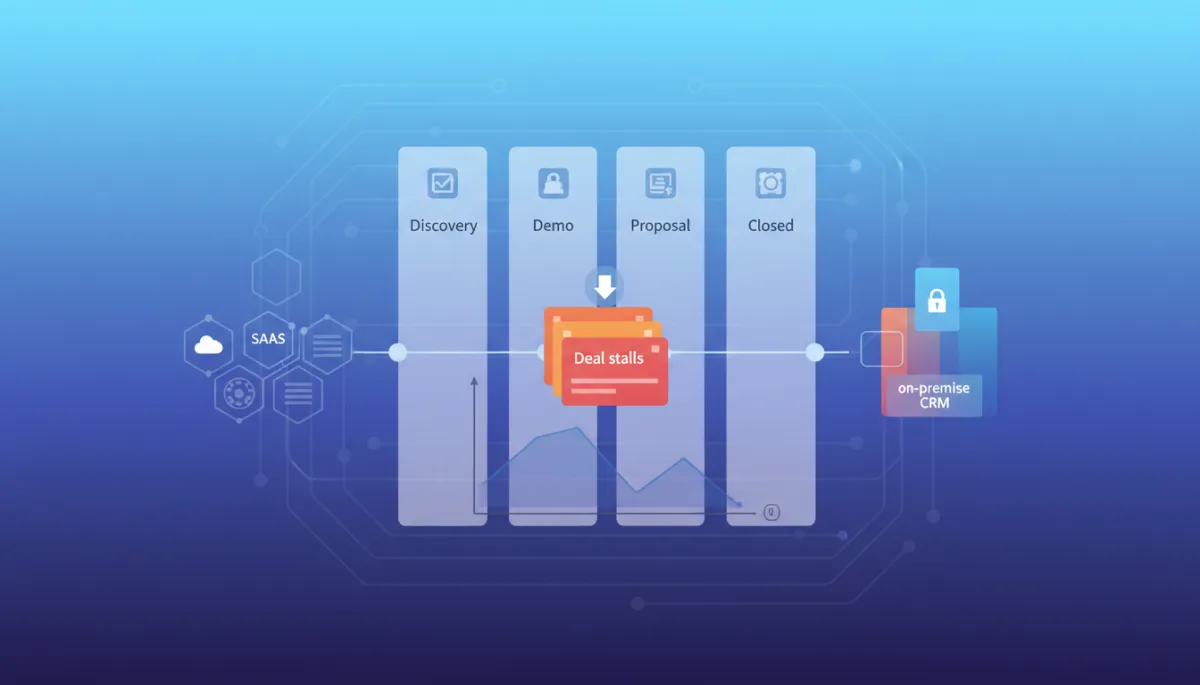
Choosing the right CRM in 2026 is less about ticking feature boxes and more about building a revenue engine: a system that surfaces stalled deals, keeps remote SaaS teams aligned, and scales without blowing up your budget. This guide walks through the 11 best CRM solutions, compares SaaS vs. on‑premise, and shows how visual, Kanban-style pipelines help you spot problems—like a pile‑up of opportunities stuck in “Demo” a week before quarter‑end—before it is too late.
Why CRM Choice Matters More for SaaS in 2026
For SaaS companies, revenue is a function of pipeline visibility as much as product-market fit. Long sales cycles, product‑led trial flows, and multi‑stakeholder deals mean you need a CRM that:
Makes it obvious when deals stall in key stages like Demo or Security Review
Supports remote and hybrid teams with cloud access and strong automation
Integrates with your marketing, billing, and product analytics stack
Most modern leaders lean toward SaaS CRM—Gartner expects the majority of CRM deployments to be SaaS-based by 2026 for scalability and integration benefits—but on‑premise still has a place for highly regulated or security‑sensitive environments.
The 11 Best CRM Software Solutions for 2026
Below are 11 stand‑out CRM platforms in 2026, based on expert reviews and user ratings across Zapier, G2, Software Advice, Toolradar, TechRadar, Forbes, and others. Pricing is approximate and may vary by region and billing term.
Salesforce Sales Cloud / Agentforce Sales – The most extensible, enterprise‑grade option. Known for deep customization, workflow automation, and AI insights via Einstein. Strong visual pipeline dashboards and forecasting make it ideal for complex SaaS sales organizations. Entry plans start around US$25/user/month (Zapier; Software Advice).
HubSpot CRM & Sales Hub – Versatile, with a generous free tier and intuitive visual pipelines. Excellent for SaaS startups and SMBs that need quick deployment and tight marketing‑sales alignment. Sales Hub paid tiers start around US$20/user/month and HubSpot ranks #1 on Toolradar’s 2026 list across 486 tools.
Zoho CRM – Value‑packed with AI assistant Zia, robust automation, and multiple pipeline views (list, table, optional Kanban). Pricing from roughly US$14–20/user/month makes it attractive for cost‑conscious SaaS teams scaling globally (G2; Software Advice; Forbes Advisor).
Pipedrive – A pipeline‑first CRM built around a clean, Kanban-style board. Drag‑and‑drop deal cards between stages, set probability and expected close dates, and instantly see where batches are stuck. Commonly rated among the easiest CRMs to use for SMBs (G2), with plans around US$12–24/user/month.
Close – Designed for outreach‑heavy SaaS teams with built‑in dialer, email, SMS, and real‑time reporting. Great if your main bottleneck is activity volume and follow‑through rather than configuration complexity. Pricing around US$49/month (G2).
Freshsales (Freshworks) – Combines intuitive drag‑and‑drop pipelines with Freddy AI for next‑best‑action recommendations, email summaries, and stall detection. Ideal for small to mid‑size SaaS businesses that want AI help without enterprise overhead, starting near US$15/user/month (TechRadar).
Zendesk Sell – A sales CRM with a highly usable interface and strong mobile experience, perfect for field‑heavy or on‑the‑go SaaS sales teams. Visual pipelines and quick activity logging keep reps current from their phones (TechRadar).
Monday CRM (Monday Sales CRM) – Built on Monday.com’s work management boards, offering Kanban, timeline, and custom views. Great for startups that want a unified place to manage deals, onboarding tasks, and customer projects. Highlighted by Forbes Advisor for its intuitive design and rapid onboarding.
Insightly – Combines CRM with project management, ideal for SaaS companies that deliver implementation or custom work post‑sale. You can track a deal from first touch through onboarding in one system. Named “Best CRM Overall” by CRM.org’s panel for this end‑to‑end approach.
HighLevel – A marketing‑centric CRM popular with agencies and SaaS resellers. Focuses on automation, funnels, and unified communication, making it well‑suited for high‑velocity lead generation combined with pipeline tracking (G2 2026 list).
SAP Sales Cloud & CRMOne – Enterprise‑class options focused on scalable workflows, complex permissions, and deep integration with finance and ERP. Best for larger SaaS or B2B tech organizations with strict governance and global operations (G2 2026 list).
SaaS vs. On‑Premise CRM: A Buyer’s‑Guide Comparison for 2026
The deployment model you choose shapes everything from cash flow to compliance. Here is a concise buyer’s‑guide comparison tailored to SaaS businesses.
Factor SaaS CRM On‑Premise CRM Upfront cost Low; subscription (OpEx). Ideal for SaaS startups and scale‑ups (Forbes Tech Council). High; licenses, servers, IT staff (CapEx). Accessibility Browser‑based; great for remote and distributed teams. Often limited to VPN/office network; extra work for hybrid teams. Updates & maintenance Automatic; vendor manages patches, new features, and security (Gartner). Your IT team handles upgrades, testing, and downtime windows. Customization depth Strong but within vendor’s framework; enough for most SaaS GTM motions. Potentially unlimited; can mirror highly specific legacy processes. Security & compliance Vendor‑managed security; strong for most, but some industries prefer full control (CRM Switch). Data stays on your servers; suitable for strict regulatory requirements. Integrations Typically rich cloud app ecosystem (billing, product analytics, support). Strong with internal legacy systems; cloud integrations can be harder.
📌 Key Takeaway: For most SaaS companies, a SaaS CRM (Salesforce, HubSpot, Pipedrive, Zoho, Freshsales, Monday CRM) delivers the fastest time‑to‑value. On‑premise is best reserved for edge cases where data residency, bespoke integrations, or regulatory constraints outweigh the benefits of cloud agility.
Visual, Kanban‑Style Pipelines: Your Early‑Warning System for Deal Stalls
In 2026, virtually every leading CRM offers a visual pipeline view—often Kanban-style—where each stage (Lead, Qualified, Demo, Proposal, Legal, Closed Won/Lost) is a column and each opportunity is a card you drag between stages. Tools like Pipedrive, HubSpot, Monday CRM, Salesforce, Zoho, and Freshsales all support this pattern (Streak; PipelineCRM; TechRadar).
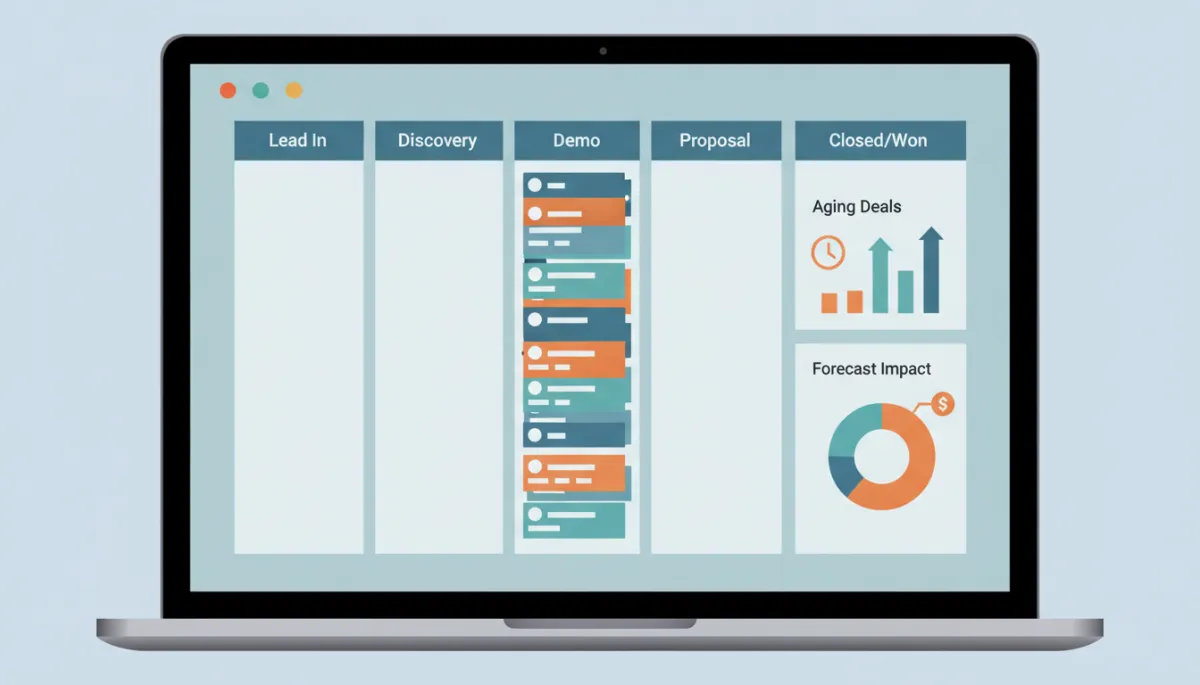
Visual pipelines highlight stage bottlenecks so SaaS teams can act before quarter-end.
Spotting a “Demo” Stage Pile‑Up Before It Hits Your Forecast
Imagine you are two weeks from quarter‑end. You open your CRM and see the Demo column overflowing with cards, while Proposal and Closed Won look thin. That visual imbalance is your first signal that:
AEs are booking demos but not progressing them (weak follow‑up or unclear next steps)
Your demo script is not aligned with buyer expectations, causing post‑demo drop‑off
You are over‑qualifying into demo and under‑qualifying into proposal
A Kanban‑style pipeline makes this visible at a glance. CRMs like Pipedrive and HubSpot let you filter that Demo column by age, deal value, and owner, so you can quickly identify which high‑value SaaS deals have been sitting for 10+ days without a scheduled next step.
💡 Pro Tip: Create a simple rule in your CRM: any deal in Demo for more than seven days without a next meeting is flagged “At Risk.” Many tools, including Freshsales (with Freddy AI) and Salesforce Einstein, can automate these alerts and even suggest follow‑up emails (TechRadar; Salesforce ISG Buyers Guide 2026).
Practical Features to Look For in Visual Pipelines
Drag‑and‑drop Kanban boards: Standard in Pipedrive, Monday CRM, HubSpot, Zoho (optional view), and Freshsales. This keeps pipeline hygiene simple for reps—no clunky forms required (Streak; PipelineCRM).
Stage‑level analytics: Look for win‑rates, average days in stage, and conversion rates from Demo → Proposal → Closed Won. Salesforce, HubSpot, and Zoho all provide these metrics natively.
Multiple pipelines: Useful if you run separate motions (self‑serve to sales‑assist, mid‑market, enterprise). Pipedrive and Pipeline CRM support multiple parallel pipelines out of the box (PipelineCRM).
AI‑driven stall alerts: Freshsales’ Freddy AI, Salesforce Einstein, and even emerging tools like Rapitek can surface deals that are likely to slip based on age, engagement, and activity patterns.
How to Choose the Right CRM for Your SaaS Business
Use these steps to narrow the field from “11 best” to a short list that fits your team:
Clarify your motion. Are you running high‑touch, enterprise deals (Salesforce, HubSpot, SAP Sales Cloud) or high‑volume, transactional sales (Pipedrive, Close, Freshsales)?
Define your non‑negotiables. Common must‑haves for SaaS include visual pipelines, email automation, integrations with billing and product analytics, and strong reporting (TechnologyAdvice; Slack CRM guide).
Map your tech stack. If you rely heavily on a marketing automation platform, support desk, or data warehouse, confirm native integrations or robust APIs before committing.
Test with real deals. Use free trials or sandboxes to run a live pipeline for 2–4 weeks. Ask: can leaders instantly see where deals are stuck? Do reps keep data up to date without nagging?
Validate with reviews. Cross‑check your impressions against G2, Capterra, Software Advice, and Toolradar for up‑to‑date feedback on usability, support, and reliability.
Final Thoughts: Make Your CRM a Revenue Practice, Not Just a Tool
The “best” CRM for 2026 is the one your SaaS team actually uses—and that gives leadership a clear, real‑time view of the pipeline. For many, that means a SaaS CRM like Salesforce, HubSpot, Pipedrive, Zoho, Freshsales, or Monday CRM, paired with disciplined use of Kanban‑style boards and stage‑level analytics. Get those foundations right, and identifying a batch of stalled Demo‑stage deals becomes a daily habit, not a last‑minute scramble at quarter‑end.
