
Top 13 AI Marketing Bots for Business Success
Marketing, AI Tools, Productivity
13 Best AI Marketing Bots I Actually Use to Run My Business
As a professional content writer who lives inside marketing dashboards, I don’t just test AI bots—I rely on them every single day for lead lists, blog drafts, and chatbot responses. Here are the 13 AI marketing bots that genuinely earn their keep in my business right now.
Why I Built an AI “Bot Stack” for My Marketing
Over the last two years, AI has quietly become the backbone of my marketing workflow. I’m not alone: HubSpot’s 2026 State of Marketing report found that roughly two-thirds of marketers say AI has boosted productivity, often saving over 10 hours a week in the process. In my case, that looks like faster lead research, first-draft content in minutes, and chatbots that handle a big chunk of routine questions before I ever step in.
Boston Consulting Group (BCG) goes even further: their research suggests that by 2025, AI could cut marketing costs by 20–30% when teams fully lean into automation and agentic workflows. I see that trajectory in my own numbers—less spent on freelancers for repetitive tasks, and more of my time going into strategy and creative direction instead of manual grunt work.
The 13 AI Marketing Bots I Actually Use
I organize my AI bots into three buckets: lead list builders, content and blog draft generators, and chatbots / automation agents. Many tools cross those boundaries, but this is how I use them day to day.
Lead Lists & Outreach Bots
HubSpot Marketing Hub (Breeze AI & AI Agents) – HubSpot is my central nervous system. Breeze AI helps me score and prioritize leads automatically, then suggests the best send times and subject lines. I use simple workflows so that when someone downloads a lead magnet, an AI-powered sequence nurtures them before I ever write a custom email. It’s my main “always-on” lead list bot connected to my CRM.
Salesforce Pardot (for larger B2B clients) – For enterprise clients on Salesforce, I tap into Pardot’s AI-driven lead scoring and segmentation. I’ll often design the scoring logic and let Pardot’s AI refine who is “sales ready,” so sales teams aren’t wasting time on cold or misaligned leads.
Instantly.ai – When I need scalable outbound, Instantly.ai is my go-to cold email bot. I feed it a tightly defined ICP, and it helps build prospect lists, personalize outreach, and handle follow-ups automatically. I still write the core messaging, but the AI handles variations and timing across hundreds of inboxes.
Zapier (AI Actions) – Zapier isn’t a traditional “bot,” but with AI actions it behaves like one. I use it to grab new leads from forms, enrich them with data, and route them into HubSpot or a Google Sheet. It also triggers personalized AI-written follow-up emails when someone hits specific lead score thresholds.
Blog Drafts, Content Pipelines & SEO Support
Jasper AI (Agent Mode) – Jasper is my main blog-draft engine. I maintain brand voice guidelines inside Jasper, then spin up agents for specific clients or campaigns. My typical flow: I outline the piece, Jasper generates a full draft, and I come in as editor-in-chief. This alone has cut my drafting time by more than half.
FlowHunt – When I’m building SEO-focused content clusters, FlowHunt helps with keyword research, content briefs, and draft generation. I treat it as my “SEO strategist bot,” especially for long-tail topics where I need structured internal linking and consistent on-page optimization.
Semrush with AI Copilot – Semrush is my analytics and SEO visibility companion. The AI Copilot flags content opportunities, surfaces competitor gaps, and even highlights how my clients’ brands show up in AI chatbot answers. I’ll often pair Semrush data with Jasper drafts to tighten targeting and keyword coverage.
Clearscope – When a piece needs to rank, I run it through Clearscope. Its AI suggestions on headings, entities, and readability help me transform a good Jasper or FlowHunt draft into something that can compete on page one. I think of Clearscope as my “content optimization bot” sitting at the end of the pipeline.
Make (formerly Integromat) – Make glues everything together. I use it to connect content drafts, project management tools, and publishing platforms. For example, once a blog is approved in my task manager, Make can push it into a CMS draft, generate social snippets via an AI module, and notify the client—all automatically.
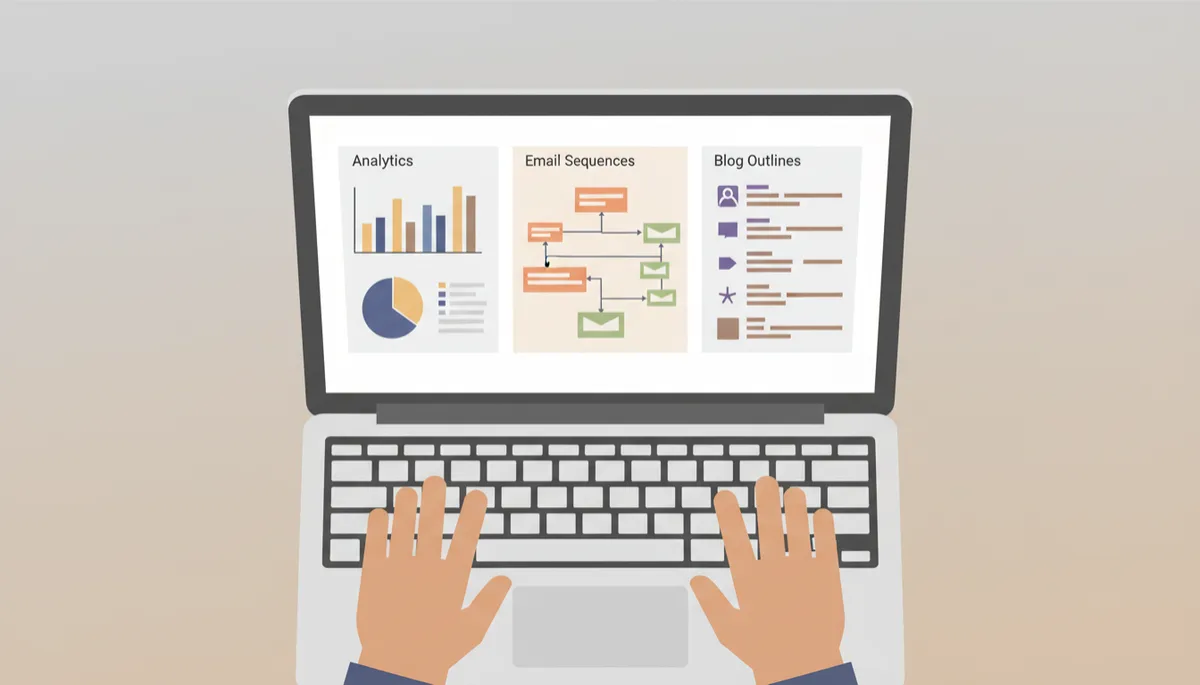
Coordinated AI bots now handle research, drafting, and reporting before I refine the work.
Chatbots, Campaign Optimization & Personalization
HubSpot Chatbots & AI Agents – On my site and several client sites, HubSpot’s chatbots handle first-touch conversations. I use AI to personalize greetings based on traffic source and to qualify leads with a few smart questions. When someone is serious, the bot routes them to my calendar or a human rep with all context attached.
ActiveCampaign – For list-centric businesses, ActiveCampaign’s AI is excellent at predicting send times and nurturing sequences. I use it to test variations of chat-style email copy and to automatically move subscribers between segments based on behavior, without manually rewriting every path.
Brevo (formerly Sendinblue) – Brevo is my budget-friendly bot for smaller clients who still want AI-powered subject lines, SMS, and WhatsApp campaigns. I often plug Brevo into a simple website chatbot so visitors can opt into sequences via chat, then continue the conversation in their inbox or phone.
Mutiny – When a client is ready for serious website personalization, I bring in Mutiny. Its AI tests headlines, CTAs, and page layouts automatically for different segments. I still write the base copy, but Mutiny’s bot iterates and optimizes, especially for high-value B2B account visitors.
Albert.ai – For paid media, Albert.ai acts like an autonomous campaign manager. I set goals, guardrails, and creative assets; Albert handles bid adjustments, audience tweaks, and cross-channel budget shifts. It’s especially helpful when I don’t have the bandwidth to micro-manage every ad set daily.
How These Bots Actually Change My Week
When I map it out, these 13 bots now touch almost every part of my marketing funnel. Lead list bots keep my pipeline full without endless spreadsheet work. Drafting agents give me solid first passes on blogs, emails, and landing pages so I can focus on voice, nuance, and strategy. Chatbots and optimization agents keep campaigns running and improving while I’m in meetings or deep work.
The net effect lines up with the industry data: I easily save 10+ hours a week compared with my pre-AI workflow, and my effective “cost per deliverable” has dropped sharply. That’s exactly the kind of 20–30% marketing cost reduction BCG forecasts as AI scales across working and non-working spend—except I’m feeling it directly in my calendar and P&L.
💡 Practical takeaway: Don’t start by buying every AI tool on the market. Start with one lead bot, one drafting bot, and one chatbot, then expand only when you can clearly see the hours and costs you’re getting back.
Final Thoughts: Build a Bot Stack That Matches Your Stage
You don’t need all 13 of these bots on day one. If you’re early-stage, a combination like HubSpot + Jasper + a simple chatbot might be enough to reclaim those first 10 hours a week. As you grow, platforms like FlowHunt, Semrush, Mutiny, and Albert.ai can help you squeeze out the extra 20–30% efficiency BCG says is on the table.
The real win isn’t just lower costs—it’s what you do with the time you get back. For me, that means more strategy, better storytelling, and deeper client relationships, while my AI bots quietly handle the busywork in the background.
