7 AI Automation Use Cases for Marketing Success
Marketing, AI Automation
AI Automation Examples: 7 Proven Use Cases to Streamline Marketing
AI has moved from buzzword to backbone in modern marketing. HubSpot’s 2026 State of Marketing data shows that smart automation can cut the manual marketing workload by up to 88%, with benefits compounding as systems keep learning from every click, open, and conversion. For practitioners, the question is no longer “Should we use AI?” but “Where does it move the needle most?”
Why AI Automation Is Reshaping Day-to-Day Marketing Work
In HubSpot’s 2026 reporting, marketers who lean into AI and automation are not just saving time—they’re redesigning how work gets done. Workflows that once took hours of spreadsheet wrangling, manual tagging, and content versioning now run in the background. HubSpot’s data indicates up to an 88% reduction in manual workload for teams that fully automate core tasks, from lead nurturing to reporting, and those gains grow over time as models continue to learn and refine decisions with every campaign cycle.
Against that backdrop, here are seven proven AI automation use cases that consistently streamline marketing while protecting the human time you need for strategy, creativity, and experimentation.
1. AI-Powered Audience Segmentation That Never Stops Learning
Audience segmentation is where AI automation quietly delivers some of the biggest gains. Instead of static lists built on a handful of rules, AI-driven systems continuously cluster people based on hundreds of signals—behavior, content consumption, device, purchase patterns, and more. Research on AI-powered segmentation shows brands can see a 20–30% lift in conversions and up to 40% more revenue from personalized journeys compared with rule-based segments.
Crucially, AI doesn’t just slice audiences; it makes personalization more practical. HubSpot’s generative AI findings highlight that 77% of marketers using generative AI say it helps them create more personalized content. When your segments are continuously refreshed and your messaging is tailored at scale, every email, ad, and on-site experience becomes more relevant—without adding hours of manual list-building each week.
💡 Practitioner takeaway: Start by automating segmentation on one key channel—email, paid social, or lifecycle messaging—then expand once you see the lift in engagement and conversion.
2. Discovering Hidden High-Value Segments: The Mobile Micro-Audience Story
One of the most powerful aspects of AI-led segmentation is its ability to surface segments that a human analyst would almost certainly overlook. Consider a mid-market ecommerce brand that plugged AI-driven analytics into its CRM and web data. Within weeks, the system identified a small but exceptionally high-converting segment: repeat visitors on newer Android devices, browsing late at night from a specific set of metro areas, almost always via mobile search—not email or social.
This group represented less than 4% of total traffic but converted at nearly three times the site average when shown a streamlined mobile checkout and time-limited offer. Because the segment was tiny, cross-cut by device, time of day, and geography, it would have been buried in a typical manual report. The AI model not only surfaced the pattern but automatically created a segment and recommended a mobile-first, late-night campaign. The result: a meaningful bump in revenue from a slice of the audience the team didn’t even know existed.
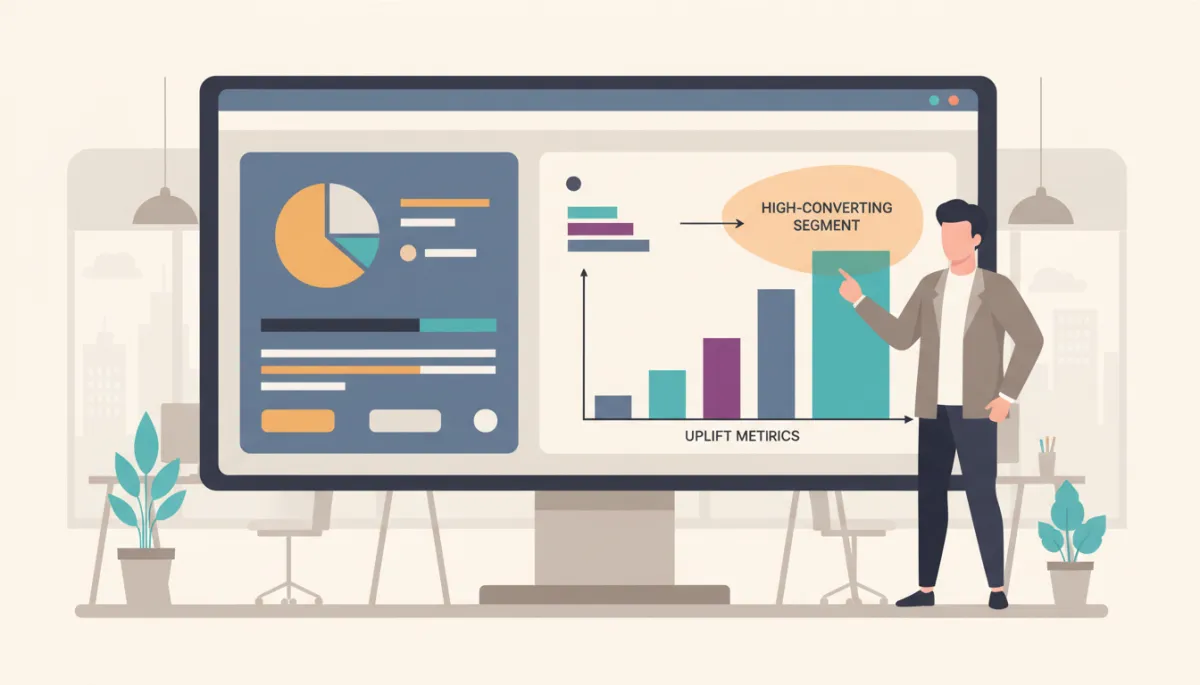
Hidden micro-segments often deliver outsized ROI once AI brings them into focus.
3. Always-On Lead Scoring and Qualification
Traditional lead scoring relies on static rules: job title, company size, a few behaviors. AI-based scoring ingests far more context—content viewed, sequence of actions, channel of origin, historical deal data—and continuously recalibrates what “high intent” looks like. HubSpot’s data on AI-powered go-to-market teams shows those using AI assistants for targeting and follow-up generate significantly more leads and better pipeline quality than those who don’t.
For practitioners, the impact is twofold: marketing automation can route the right leads to sales at the right moment, and lower-intent contacts can automatically enter nurture tracks instead of clogging sales queues. The result is less manual triage, fewer misaligned handoffs, and more time spent on genuinely sales-ready conversations.
4. Generative Content Production and Versioning at Scale
AI content tools are now deeply embedded in marketing workflows. According to HubSpot’s 2026 State of Marketing, around 80% of marketers use AI for content creation and 75% for media production. The productivity win isn’t just in drafting first versions; it’s in automated versioning: turning one core idea into channel-specific posts, A/B test variants, subject line options, and ad copy tailored to different segments.
When this generative layer is tied to your segmentation engine, you get a powerful loop: the system knows who you’re talking to and can automatically adjust tone, length, and offer. That’s where the earlier statistic—77% of generative AI users seeing better personalization—translates directly into higher engagement and conversion, without ballooning your content calendar or headcount.
5. Automated Journey Orchestration and Nurture Flows
AI doesn’t just send the next email in a prebuilt sequence; it can decide which touchpoint should come next based on real behavior. Modern journey orchestration tools use AI to choose the best channel, timing, and message for each individual—whether that’s a reminder email, a retargeting ad, or an in-app prompt. HubSpot’s Marketing Studio and Loop playbooks are examples of this shift toward intelligent, adaptive flows rather than rigid drip campaigns.
Practically, this means fewer dead-end nurture paths and more prospects quietly progressing toward readiness with minimal manual intervention. Marketers set guardrails and goals; AI handles the micro-decisions in between.
6. Performance Analysis, Optimization, and Budget Reallocation
In HubSpot’s 2026 data, 92% of marketers already use automation for data analysis and reporting. The next level is letting AI not only summarize performance but recommend and, in some cases, execute changes. Models can automatically pause underperforming ads, shift budget to winning audiences, or recommend new content angles based on emerging engagement patterns across channels.
This is where that headline figure—up to 88% less manual work—comes to life. Instead of spending hours every week exporting CSVs and building slide decks, practitioners can review AI-generated summaries, validate suggested optimizations, and focus their time on higher-order strategy and experimentation.
7. Answer Engine Optimization and Always-On Search Visibility
As search shifts toward AI-driven answer engines, marketers are using automation to keep content discoverable. HubSpot’s AEO (Answer Engine Optimization) playbook, for example, uses AI to identify question clusters, structure content for LLM-style responses, and monitor which pages drive the most qualified leads. In one deployment, this approach delivered 1,850% more qualified leads and a threefold increase in conversion compared with traditional SEO tactics.
For practitioners, AI-powered AEO means less manual keyword guesswork and more systematic, data-backed content planning that aligns with how people actually ask questions across search, chatbots, and voice interfaces.
Making AI Automation Work in the Real World
The throughline across these seven use cases is simple: AI excels at pattern recognition, repetition, and rapid iteration. Marketers excel at context, judgment, and storytelling. When you let automation handle the former, you reclaim the time and headspace to focus on the latter—deciding which segments matter most, what stories you want to tell, and how your brand should show up in a crowded, AI-saturated landscape.
📌 Key takeaway: Start where the friction is highest—often segmentation, content versioning, or reporting—then layer in additional AI automations as your data, processes, and team confidence mature.
With HubSpot’s 2026 data showing that AI automation can remove up to 88% of the manual workload and that personalization improves dramatically for the 77% of marketers embracing generative tools, the opportunity is clear. The teams that win won’t be the ones doing more busywork faster—they’ll be the ones who let AI handle the busywork so they can spend their time on the kind of marketing only humans can do.
